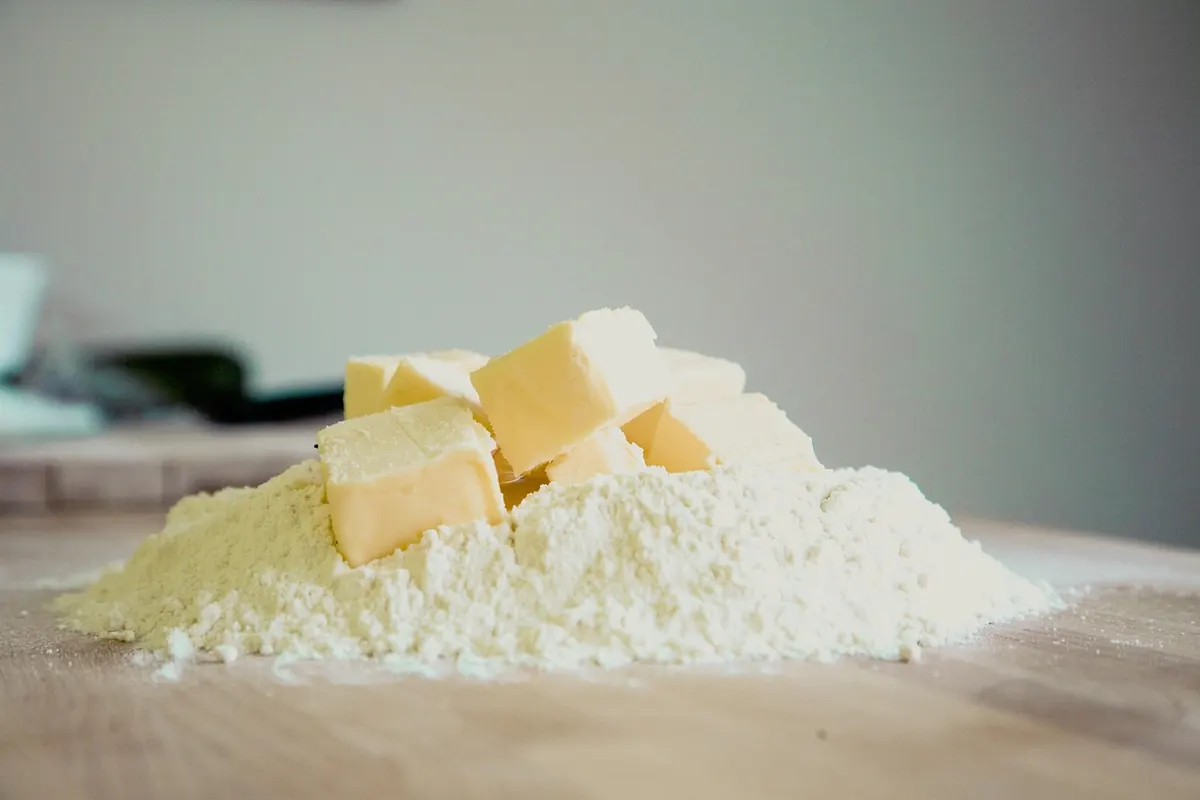
Laminated Dough at Home: Butter vs. Margarine Comparison
The first time you roll a block of cold butter into a yeasted dough and fold it three times, you learn something no recipe states outright: the fat is not an ingredient here, it is the architecture. Choose butter and you get croissants that smell of cream and break into papery shards. Choose margarine and you get dough that behaves calmly in a warm kitchen and bakes up even, golden and slightly anonymous. Neither choice is a mistake. They are different tools, and knowing which one is in your hand is the difference between a frayed Sunday morning and a good bake.
What the Fat Is Actually Doing Between the Layers
Before comparing the two, it helps to be clear about the job. In laminated dough you are building a stack of dough sheets separated by fat. During baking, the water inside the fat turns to steam and pushes the layers apart, while the fat melts and fries the gluten sheets from the inside, setting them crisp before they can merge. If the fat is too soft when you roll, it smears into the dough and you lose the separations — bakers call it blending, and it is the reason a warm kitchen produces brioche-textured croissants. If the fat is too hard, it cracks under the pin, tears the dough, and leaves you with broken layers and butter leaking out at the edges.
So the real question is not butter or margarine in the abstract. It is which fat keeps a workable consistency across the temperatures you actually have.
Butter: Flavour You Cannot Imitate, a Window You Cannot Ignore
Butter brings 82 to 84 percent fat in the European style, with the rest mostly water and a little milk solids. Those solids are what brown so beautifully on the crust and what give laminated pastry its unmistakable dairy perfume. The trade-off is a narrow plastic range. Butter is pleasant to roll somewhere around 13 to 18 °C; below that it shatters, above it turns greasy and disappears into the dough.
Practical consequences worth planning for:
- Work in a cool room, and chill the dough for at least 30 minutes between folds — 45 if your kitchen is above 24 °C.
- Use a dry, high-fat butter if you can find it (often sold as beurre de tourage or dry butter), because less water means less shrinkage and a crisper bake.
- Match firmer textures: the butter block and the dough should feel equally yielding. If one is stiffer, the layers will be uneven.
- Proof on the cooler side, around 26 °C, so the butter does not melt before the dough has risen.
Butter also releases steam as it bakes, and that steam is part of the lift. The downside is a pastry that softens faster once cool, so plan to eat it the same day or refresh it in a hot oven for a few minutes.
Margarine: The Steady Hand in a Warm Kitchen
Margarine is a blend of vegetable fats and water, formulated to behave like butter at a lower cost and with a wider working range. The version that matters for lamination is block pastry margarine, made with fats that melt at a higher temperature. It stays plastic across a broader band, resists smearing, and holds crisp, defined layers even when your kitchen is not cooperating.
What you give up is mostly on the palate. Margarine has no cultured dairy flavour, browns less, and good versions can still leave a faint waxy film on the roof of your mouth. Cheap ones taste of nothing much at all, which in a pastry whose whole appeal is buttery fragrance is a real loss.
Two practical cautions. First, read the label: block margarine for laminating is a different product from soft tub spread, which contains too much water and the wrong fat structure — it will ruin your layers. Second, margarine's water content varies more between brands than butter's, and some are salted, so taste your dough before you add extra salt.
How They Compare, Side by Side
- Flavour: butter wins clearly, and it is not close. Margarine reads as neutral at best.
- Temperature tolerance: margarine is more forgiving. Butter demands discipline and a cold work surface.
- Lamination results: butter gives irregular, blistered, dramatic layers and a shattering crust; margarine gives even, uniform, tidy layers that hold their shape in the oven.
- Browning: butter browns deeply thanks to its milk solids; margarine tends to stay paler unless the dough carries sugar or egg wash.
- Keeping quality: margarine pastries stay tender longer; butter pastries are at their best within hours of cooling.
- Cost and shelf life: margarine is generally less expensive and keeps far longer in the fridge or freezer.
Blending the Two Without Compromising the Bake
You do not have to pick a side. A useful compromise is a block that is roughly four parts butter to one part pastry margarine. Soften the butter just enough to be pliable, work the margarine through it with a spatula until the block is uniform, then press it into a square and chill it firm. The butter carries the flavour and the browning; the margarine widens the temperature window and firms up the layers. In a hot July kitchen, that difference is noticeable — the block holds together through the third fold instead of threatening to slide apart.
If you bake in a genuinely warm room and want to stay all-butter, work in shorter bursts. Roll, fold, wrap, and return the dough to the fridge before it starts to feel tacky. Ten minutes of chilling costs you nothing and saves the batch.
And if you are making the switch from margarine to butter, expect the dough to feel different in your hands rather than worse. Butter dough often needs one extra rest to relax, particularly before the final roll-out.
A Practical Plan for Your Next Bake
Start with butter. Make one batch of croissant or puff dough with a good European butter, keep everything cold, and taste the result while it is still warm. That gives you a reference point for flavour and crumb that no description can replace.
Then bake a second batch with block pastry margarine, in the same week if you can, and compare them side by side. Note how the dough handled, how the layers opened, how the crust coloured, and how each tasted two hours later. Most home bakers find their answer quickly: butter for the bake they plan to serve that day, margarine for the one that has to survive a warm kitchen or a busy schedule.
Whichever you choose, treat the fat as the thing you are really making. Keep it cold, keep it even, and roll with a light hand. The layers will tell you whether you got it right before the oven ever comes into play.
Photo: markusspiske / Pixabay